Journal of Physical Education, Recreation & Dance (JOPERD)
SHAPE America’s cornerstone journal, the peer-reviewed JOPERD, has been continuously published since 1896. Appealing to practitioners and academics alike, it reaches 12,000+ readers and provides a greater variety of information on health, physical education, recreation, and dance issues than any other publication in the field.
September 2026
Volume 97, Issue 9
Member subscribers: Sign in to view current issue
Not a member/subscriber? Join SHAPE America and select JOPERD as your journal
Join Now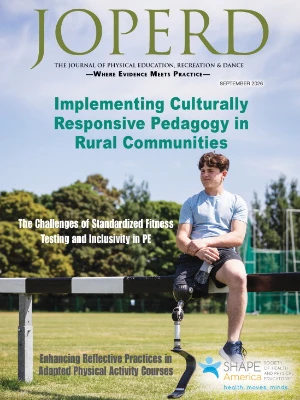
Free Access Article
Country Physical Education: Considerations for Implementing Culturally Responsive Pedagogy in Rural Communities
– Thomas Wilson
This article offers a guide for preservice and inservice general and adapted physical education practitioners who serve in rural communities. Every student has a culture. As such, all students benefit from educators implementing culturally responsive pedagogy across academic disciplines, including in physical education. The article aims to inform physical educators of best practices for implementing culturally responsive pedagogy within rural communities by answering the following questions: (a) Where and what is considered rural? (b) What populations live in rural communities? (c) What is culture? (d) What is culturally responsive pedagogy? (e) Why it is crucial to implement culturally responsive pedagogy in rural physical education classes? (f) How does one implement culturally responsive pedagogy in rural physical education classes? And (f) what special consideration should be given to students in rural physical education classes?
Articles
Enhancing Reflective Practices in Undergraduate Experiential Learning: A Guide for Adapted Physical Activity Courses
– Fabián Arroyo Rojas and Joonkoo Yun
Reflection is a common practice across experiential learning experiences. Despite its common use, little is known about how reflective practices take place in experiential learning opportunities. Drawing from theoretical perspectives of reflection, the purpose of this article is to provide a practical approach to reflection within an adapted physical activity course to maximize undergraduate students’ learning. First, this guide provides pre-service teachers an opportunity to engage in reflection in the experiential learning experience by evaluating the context, cultural aspects, and previous experiences in physical education. Second, a sequential approach is offered to evaluate each session and preconceived ideas regarding disability. This guide should facilitate thinking about how to improve the preparation of future adapted physical activity service providers.
The Challenges of Standardized Fitness Testing and Inclusivity in Physical Education
– Sheldon Sucre
Standardized fitness tests have become a widely used tool to assess the five components of health-related fitness in physical education (PE). While these tests provide beneficial information, they can reinforce binary hegemonic structures within PE that can “other” marginalized communities. “Othering” involves perceiving individuals or groups as inferior based on their race, gender, or cultural background, thereby reinforcing their marginalization. In fitness testing, this often manifests as a focus on competition and adherence to White and hyper-masculine norms. It can also create a normalization around body types that are muscular and thin. Also, it can marginalize students who do not fit those body types. The field needs to offer diverse assessment options that emphasize personal growth and improvement without comparison. This article discusses the need to incorporate culturally relevant, culturally responsive, and culturally sustaining pedagogy in relation to fitness testing.
Swinging into Success: Teaching Golf with Specialized Content Knowledge in Physical Education
– Insook Kim
Given golf’s growing popularity in the United States, school physical education serves as an effective and cost-efficient platform for introducing fundamental golf skills and sparking interest among children and youth. To teach golf successfully in physical education, teachers require sophisticated, specialized content knowledge going beyond performing basic skills and knowing game rules. This article presents teaching resources designed to enhance the specialized content knowledge of both preservice and inservice physical education teachers for teaching golf. Included is a comprehensive packet featuring common performance errors with corresponding error corrections, and a sample 15-day block plan for instruction.
Youth Sport Day: Supporting Sport Sampling through University-Community Collaboration
– Hannah Swartz, Christina Villalon, and Kristen Dieffenbach
Youth sport sampling offers significant physical, psychological, and social benefits by encouraging young athletes to engage in multiple sports before specialization. This approach enhances physical literacy, fosters intrinsic motivation, and mitigates risks associated with early specialization, such as burnout and overuse injuries. Despite these benefits, access to sport sampling opportunities remains limited due to financial constraints, time commitments, geographic disparities, and social pressures favoring early specialization. This article underscores the role of university–community partnerships in advancing youth physical activity and addressing access barriers through sport sampling events, specifically highlighting the development of a Youth Sport Day. Organized in collaboration with university athletic departments, Youth Sport Day provides children ages 10 and under with exposure to multiple sports in an accessible, inclusive, and low-cost environment. The article details the event’s design, planning, and execution, including the involvement of faculty, students, and community partners, and provides recommendations on how to develop one’s own youth sport sampling event.
Grow as a Student Coach: Practical Insights on Integrating Three Teaching Styles into the Sport Education Model
– Hairui Liu, Wei Mao, and Peter Hastie
The instructional quality of student coaches plays a critical role in the effective implementation of the Sport Education Model (SEM). This article offers practical pedagogical strategies to strengthen student coaching behaviors within the SEM by purposefully integrating three teaching styles: learner-initiated (Style J), learner-designed individual program (Style I), and reciprocal (Style C). Drawing from a university-level table tennis season, the article introduces three easy-to-implement scaffolding tools: a coach-led question sheet to guide reflective planning, a task sheet to structure instructional delivery, and a triad framework to reinforce peer feedback. These tools offer practical strategies that can support student initiative, promote content knowledge, and foster a supportive, peer-driven learning environment. By integrating these teaching styles, physical educators can access concrete strategies to support student coaches, enhance peer-learning outcomes, and promote sustained, meaningful interaction throughout a SEM season.
From Fear to Festivity: Fortifying Gymnastics via the Technology-Integrated Sport Education Model (T-SEM)
– Jin Gyu Shin
Gymnastics is often marginalized in physical education curricula due to safety concerns, teachers’ lack of confidence, and students’ anxiety regarding performance and body image. For physical educators, these challenges are often compounded by a lack of pedagogical content knowledge, leading to reliance on traditional, teacher-centered instruction. This article introduces the Technology-Integrated Sport Education Model (T-SEM) as a transformative framework for gymnastics instruction. By embedding digital tools, such as generative AI, motion analysis applications, and collaborative platforms into the specific roles of the Sport Education Model (SEM), educators create a learning environment that supports competence, relatedness, and autonomy. This article provides a comprehensive, step-by-step instructional design guide, detailing how to utilize tools like ChatGPT, Pose & Tracking, and Facebook Groups to turn a traditional gymnastics unit into a vibrant, student-led “Gymnastics Olympics.” By shifting the focus from isolated skill drills to a technologically enriched team endeavor, T-SEM offers a replicable blueprint for engaging the digital generation in physical education.
THE FUSED Health Education Series
Making Learning VISIBLE in Health Education: Part 1
– Kristen Ford and Julie Knutson
When contemplating a prevailing teaching philosophy for educators, it is critical to remember that a teacher’s job is not “just to teach;” rather, an educator’s job is to help students learn. There are a variety of ways to do this, starting with building quality student relationships and helping students feel emotionally (and physically) safe in the classroom. The next broad goal of health education involves ensuring that students have learned the functional information (information that is usable, applicable, and relevant) and essential skills (from National Health Education Standards 2-8) needed to be competent, confident, and able to go on to live health literate lives. As part of THE FUSED Health Education Series, this two-part article describes seven health education “power tools” that can make learning VISIBLE: V – View in the Mirror, I – Input < Output, S – Study Sessions, I – Intertwine, B – Back Away Slowly, L – Looping for Learning, E – The End. Part 1 describes the basic teaching and learning strategies in preparation for implementing formative and summative assessments.
Making Learning VISIBLE in Health Education: Part 2
– Kristen Ford and Julie Knutson
This article builds on Part 1 by shifting the focus from instructional strategies to assessment design in health education. While the tools introduced in Part 1 aimed to enhance student engagement, understanding, and retention, this second article emphasizes how those same strategies can support both informal and formal assessment practices. Recognizing that “informal” and “formal” assessment can be interpreted differently, this article presents a new way to imagine some foundational assessment concepts, including key terms, purposes, components, and players. The goal is to support instructional alignment, continuous feedback, and performance-based learning to help health educators make student learning both VISIBLE (V = View in the mirror, I = Input < Output, S = Spaced Studying, I = Intertwine, B = Back Away Slowly, L = Looping for Learning, E = The End) and actionable. An overview of assessment types and approaches is provided, leading to the introduction of a five-point teaching model offered as one example of how to approach planning for and applying assessments within THE FUSED Technique framework.
Departments
VIEWPOINT
A Vygotskian Approach to Learning and Teaching In Physical Education
– Sean A. Fullerton
This article will present a viewpoint of learning/teaching in physical education (PE) through the four principles of Vygotsky’s Theory that teachers can apply to support student learning and motivation.
EDITORIAL
The Biggest Issue in Physical Education is Access
– Ben D. Kern
Physical education exists in schools, but students’ access to it is often limited, fragmented, or easily reduced. These issues are symptoms of a broader structural issue. This editorial addresses the role that policy and advocacy play in addressing the problem.
TEACHING TIPS
A Proposed Progression of Teaching Techniques for Adapted Judo
– Rafael Lima Kons, Vinícius de Oliveira Souza Gulias, Thales Moreira de Souza Gondim, Maria Eduarda Passos Kraychete e Silva, Guilherme Santos,Nathalie Azeredo Bahiense Gomes, and Carolina Lima
Judo has gained considerable prominence in recent years, and there has recently been a growing interest in adapted judo for individuals with visual and intellectual disabilities. This article presents a structured teaching model for adapted judo.
TECHNOLOGY TIPS
Using Artificial Intelligence in Sports Coaching
– Hüseyin Ünlü, Veli Başal, Bijen Filiz, Ferman Konukman, and Andrew Sortwell
AI technology is also being used effectively in sports, as it is in many other fields. This article highlights several ways in which AI is being used to enhance sport coaching and offers recommendations to coaches for using AI-based tools.
HEALTH TIPS
Humanizing Health Education—Part 2
– Sarah Benes and Dylan Scanlon
Part 1 of this three-part “Health Tips” series (Benes & Scanlon, 2026) discussed the importance of considering humanizing approaches in health education and explores two aspects of humanizing pedagogy (self and students). This article (Part 2) focuses on place and context.