Journal of Physical Education, Recreation & Dance (JOPERD)
SHAPE America’s cornerstone journal, the peer-reviewed JOPERD, has been continuously published since 1896. Appealing to practitioners and academics alike, it reaches 12,000+ readers and provides a greater variety of information on health, physical education, recreation, and dance issues than any other publication in the field.
August 2026
Volume 97, Issue 8
Member subscribers: Sign in to view current issue
Not a member/subscriber? Join SHAPE America and select JOPERD as your journal
Join Now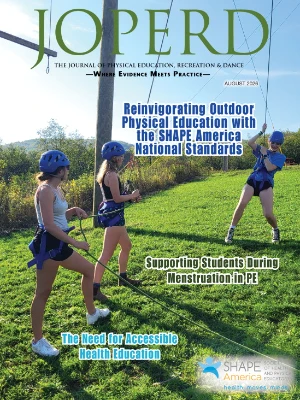
Free Access Article
Reinvigorating Outdoor Physical Education with the SHAPE America National Standards
– Mark Zmudy
Today’s students have an exceptionally high need for nurturing through social and emotional learning (SEL), as well as for overall physical and mental health. The 2024 SHAPE America National Standards present an exciting pathway for physical education teacher education (PETE) and physical education (PE) professionals to connect the well-documented medical and academic benefits of outdoor, nature-based activity to meet this high level of need. Lifetime outdoor pursuits and adventure education were incorporated into the American PE standards in 1991 to serve non-competitive learners. Over 30 years later, this need persists, and new aspects have been added. This article provides terminology used to describe different aspects of outdoor education, briefly revisits historical perspectives and the reasons for including these activities in the new National Standards, provides curricular ideas for PETE and PE professionals by showcasing an example of one PETE program that was restructured to include these concepts, and demonstrates how the standards can be used to create inclusive learning environments in P-12 PE programs.
Articles
Disrupting Negative Loops of Teacher Motivation and Well-Being in Physical Education
– Youngjoon Kim, Denis Schulz, Kelly Simonton, Karen Gaudreault, Kevin Mercier, Victori Shiver, and Kevin Andrew Richards
Physical education (PE) teachers often experience a negative loop of diminishing motivation, well-being, and performance, which can lead to ineffective teaching practices and poor student outcomes. This article explores various types of negative motivational loops that early-, mid-, and late-career PE teachers may encounter and proposes actionable strategies to disrupt these vicious cycles. Through empirically informed vignettes, the unique challenges faced by PE teachers at different career stages are illustrated. The article emphasizes the importance of individual PE teachers taking the initiative to adapt and apply the strategies within their own contexts to proactively change their status quo. Future research should focus on the psychological constructs of motivation, emotions, and well-being among physical educators, develop resources for their psychological well-being, and investigate successful cases of teachers navigating motivational and well-being crises throughout their careers.
Applying Peer Assessment in Microteaching: A Practical Approach for Physical Education Teacher Education Students
– Andy Lin
Peer assessment in microteaching offers physical education teacher education (PETE) students structured feedback and self-reflection opportunities to bridge the gap between theory and practice. While microteaching provides hands-on experience, many PETE students hesitate to express their opinions, slowing the feedback process. Peer assessment addresses this challenge by fostering structured, constructive evaluations. This article explores how integrating observation tools, such as rubrics and online platforms, enhances feedback quality, encourages participation, and supports professional socialization. Additionally, technology-enabled peer assessment reduces verbal hesitancy and allows for asynchronous feedback. A supportive learning environment with clear feedback guidelines further promotes engagement.
The Need for Accessible Health Education
– Michael Laughlin, Sarah Benes, and Rebecca Shangraw
Health education in preschool through 12th grade is an essential component of a well-rounded education and can positively impact student health and well-being. All school-age students deserve access to high-quality, effective health education. However, students with disabilities may not be receiving the health education they are entitled to for many reasons, including that there is not a clearly defined understanding of health education for students with disabilities. Working from the perspective that health education is both a social justice imperative and an important component of students’ “well-rounded education” under the Every Student Succeeds Act of 2015, this article is a call to action and brings attention to this area of need. It is framed around three critical questions: (1) Why do students with disabilities deserve access to health education? (2) How should health education for students with disabilities be conceptualized? (3) Where does accessible health education go from here? By articulating these questions and providing initial thoughts to spur further discussion and action, this article encourages invested partners and collaborators to address this critical need so that students with disabilities can meaningfully access the same high-quality health education opportunities as their peers.
Taking a Deeper Dive: Program Assessment in Physical Education Teacher Education Programs
– Claire Mowling and Sandra Sims
Physical education teacher education (PETE) programs are frequently evaluated as part of a university’s accreditation process, ensuring alignment with the National Standards. One university’s recent program evaluation led to necessary updates to key assessments, ultimately resulting in successful reaccreditation. However, accreditation alone does not guarantee continuous program improvement. To further enhance program quality, one university’s faculty conducted a follow-up evaluation utilizing the Development, Research, and Improvement (DRI) Framework and additional best-practice guidelines. The purpose of this article is to describe how the PETE program leveraged the developmental stage of the DRI framework to assess and strengthen key program components, ensuring the preparation of highly competent future physical educators. The article includes a roadmap for PETE programs to consider when evaluating their curriculum.
Building Social and Emotional Learning Skills in Preschool and Elementary-Age Children
– Tan Leng Goh and Kelly McCarthy
This article describes a six-week social and emotional learning (SEL) program that was implemented at a university’s childcare center. Physical education teacher education (PETE) students majoring in physical education assisted in the implementation of the SEL program as part of their university coursework. The program focused on achieving the 2024 SHAPE America National Health Education Standards, which are aligned with SEL competencies. Preschool and elementary age children at a childcare center participated in SEL lessons and activities delivered by the PETE students under the supervision of the director of the childcare center. The director provided students with feedback throughout the semester that helped them improve their teaching skills over time. The program provided opportunities for the PETE students to improve their pedagogical and communication skills with children, as well as to learn and practice classroom management skills in a small class setting. Furthermore, the children were able to receive personalized attention from the PETE students.
A Website for Culturally Responsive Pedagogy in Physical Education
– Melissa Bittner, Anthony Tang, Amanda Young, and Christine Galvan
This article aims to identify the ways and means for implementing culturally responsive pedagogy (CRP) in physical education (PE) curricula. CRP is an educational approach to teaching that enhances diversity, equity, and inclusion. This article describes a website that was developed to assist PE teachers in the implementation of CRP. The website provides and consolidates information on CRP principles, culturally relevant lesson ideas, professional development, and the sharing of personal stories from other teachers. Furthermore, this article reveals the issues and concerns regarding CRP in PE, including limited professional training for teachers and the issues of technology implementation. However, the article suggests that despite these challenges, the adoption of CRP has the possibility of revolutionizing PE and consequently creating a better learning environment for students.
From Shame to Empowerment: Supporting Students During Menstruation in Physical Education
– Nicola Böhlke, Benjamin Zander, and Daniel Rode
Menstruation remains a frequently tabooed topic in schools, and challenges such as physical discomfort, uncertainty, hygiene concerns, and shame-related anxieties often become particularly pronounced in physical education (PE). As a result, students may avoid or be excused from PE lessons. This article raises awareness among physical educators about how menstruation may affect students’ well-being and participation in PE. Because PE teachers are typically not trained health educators, the article does not aim to provide in-depth medical content. Instead, it offers practical pedagogical strategies to help teachers create a supportive, inclusive learning environment and respond appropriately when menstruation becomes relevant in class. To this end, the article first outlines the historical and social significance of menstruation, then presents research findings on its specific implications within PE, and finally offers practical recommendations for physical educators, with a primary focus on middle and high school settings.
THE FUSED Health Education Series
Making Learning VISIBLE in Health Education: Part 1
– Kristen Ford and Julie Knutson
When contemplating a prevailing teaching philosophy for educators, it is critical to remember that a teacher’s job is not “just to teach;” rather, an educator’s job is to help students learn. There are a variety of ways to do this, starting with building quality student relationships and helping students feel emotionally (and physically) safe in the classroom. The next broad goal of health education involves ensuring that students have learned the functional information (information that is usable, applicable, and relevant) and essential skills (from National Health Education Standards 2-8) needed to be competent, confident, and able to go on to live health literate lives. As part of THE FUSED Health Education Series, this two-part article describes seven health education “power tools” that can make learning VISIBLE: V – View in the Mirror, I – Input < Output, S – Study Sessions, I – Intertwine, B – Back Away Slowly, L – Looping for Learning, E – The End. Part 1 describes the basic teaching and learning strategies in preparation for implementing formative and summative assessments.
Making Learning VISIBLE in Health Education: Part 2
– Kristen Ford and Julie Knutson
This article builds on Part 1 by shifting the focus from instructional strategies to assessment design in health education. While the tools introduced in Part 1 aimed to enhance student engagement, understanding, and retention, this second article emphasizes how those same strategies can support both informal and formal assessment practices. Recognizing that “informal” and “formal” assessment can be interpreted differently, this article presents a new way to imagine some foundational assessment concepts, including key terms, purposes, components, and players. The goal is to support instructional alignment, continuous feedback, and performance-based learning to help health educators make student learning both VISIBLE (V = View in the mirror, I = Input < Output, S = Spaced Studying, I = Intertwine, B = Back Away Slowly, L = Looping for Learning, E = The End) and actionable. An overview of assessment types and approaches is provided, leading to the introduction of a five-point teaching model offered as one example of how to approach planning for and applying assessments within THE FUSED Technique framework.
Departments
VIEWPOINT
Physical Education for Autistic Students: Viewpoint from a Teacher Educator
– Melissa Bittner
This article addresses the importance of (a) preserving and expanding hands-on clinical opportunities in adapted physical education teacher education, (b) integrating assistive technology, and (c) providing high-quality professional development focused on supporting autistic students.
EDITORIAL
From “Figuring It Out” to “Building It Right”: Why Adapted Physical Education Preparation Must Evolve
– Heather Burd
If inclusive physical education is to move beyond intention and into sustained impact, responsibility cannot rest solely on individual teachers to compensate for systemic shortcomings. Those responsible for preparing physical educators must elevate APE as central—not peripheral—to professional competence.
TEACHING TIPS
Sport Education in Special Schools: A Framework to Guide Physical Educators’ Planning Decisions
– Jorge Abellán, Yessica Segovia, and Nieves M. Sáez-Gallego
This article presents pedagogical recommendations to design an SE season in special education schools or other special education or adapted physical education settings where all students require educational support due to intellectual disabilities and autism.
TECHNOLOGY TIPS
GoReact as a Feedback and Reflection Tool in PETE/HETE Teacher Preparation
– Ingrid Johnson, Tess Armstrong, and Rachel Fetterley
This article described the use and benefits of GoReact, a cloud-based video annotation tool that can be used to support pre-service teachers during their student-teaching experiences in Physical Education/Health Education Teacher Education programs.
HEALTH TIPS
Humanizing Health Education—Part 1
– Sarah Benes and Dylan Scanlon
Health education can be a place of both humanization and liberation, but it must be done with care and intention. This article outlines the reasons why humanizing health education is beneficial, along with strategies for health educators to implement in their health education classrooms.